
Three leadership response patterns, the risks they create, and why follow-through matters.
An employee returns after several weeks of health-related leave. Their hours have been adjusted, accommodations documented, and a return-to-work plan approved.
Everything appears to be in place.
A few days later, the employee tells their leader:
“I’m glad to be back, but I’m already worried I won’t be able to keep up.”
The leader now has a decision to make. Focus on productivity? Refer to the existing plan? Explore what is making the return difficult?
Each response can influence what happens next.
Return-to-work is often treated as an administrative milestone. Successful reintegration, however, depends on what happens after an employee returns.
The Research: Leadership Can Introduce or Reduce Risk
Return-to-work research identifies supervisors as important influences on employees’ reintegration experiences.
Research discussed by Joosen and colleagues highlights how pressure to resume previous workloads, insufficient guidance, and limited understanding can create difficulties. Other research, including work by Nielsen and Yarker, points to the importance of meaningful supervisory support beyond procedural requirements.
These findings raise an important question: How can people leaders recognize when their everyday behaviours are helping or hindering reintegration?
At Jeddy Wellness, we have translated these research insights into three illustrative leadership response patterns.
Three Leadership Responses, Different Risks
Return-to-work research identifies supervisors as important influences on employees’ reintegration experiences.
Research discussed by Joosen and colleagues highlights how pressure to resume previous workloads, insufficient guidance, and limited understanding can create difficulties. Other research, including work by Nielsen and Yarker, points to the importance of meaningful supervisory support beyond procedural requirements.
These findings raise an important question: How can people leaders recognize when their everyday behaviours are helping or hindering reintegration?
At Jeddy Wellness, we have translated these research insights into three illustrative leadership response patterns.
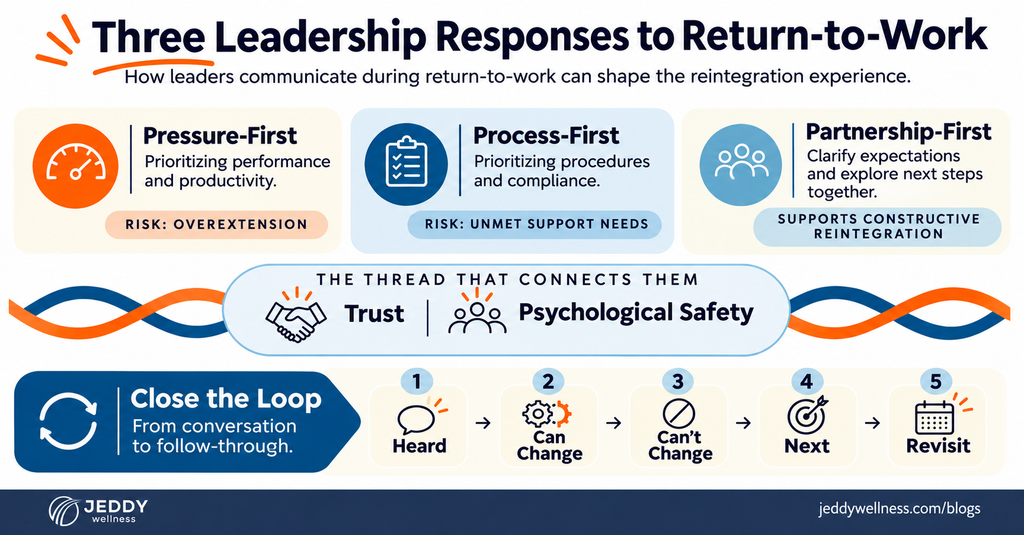
Three Leadership Responses, Different Risks
1. Pressure-first: Prioritizing performance
Deadlines, productivity, and catching up dominate the conversation.
Operational pressures are real. Work still needs to be completed, and colleagues may have absorbed additional responsibilities during an employee’s absence.
The risk emerges when urgency takes priority over understanding current capacity. Employees may feel pressure to overextend themselves or become reluctant to raise further concerns.
2. Process-first: Prioritizing compliance
The leader follows the formal return-to-work plan and established procedures.
This approach provides necessary structure and consistency. However, compliance alone may not address changing circumstances, unclear priorities, or the need for ongoing guidance.
The risk is assuming that completing the process means the employee has everything required to reintegrate successfully.
3. Partnership-first: Facilitating progress
The leader listens, seeks to understand the concern, clarifies expectations, and explores appropriate next steps with the employee.
This approach does not eliminate operational requirements or accommodation procedures. It creates opportunities to address difficulties constructively while maintaining accountability.
Partnership-first behaviours can help facilitate progress by keeping communication open.
Importantly, these are not fixed leadership personalities or a validated classification. The same leader may demonstrate all three patterns depending on organizational demands, available resources, and competing priorities.
The objective is not to label leaders as good or bad. It is to recognize behaviours, understand their potential risks, and respond more intentionally.
Trust and Psychological Safety: The Thread That Connects Them
Employees returning from health-related leave may have concerns about how their capability, commitment, or performance will be perceived.
Raising those concerns can involve interpersonal risk.
Mayer, Davis, and Schoorman’s (1995) organizational trust model identifies ability, benevolence, and integrity as important dimensions of perceived trustworthiness.
Edmondson’s (1999) research defines psychological safety as a shared team belief that it is safe to take interpersonal risks, including speaking up, asking questions, and raising concerns. More recent work by Edmondson and Kerrissey (2025) reinforces that psychological safety does not mean avoiding difficult conversations or lowering accountability.
Trust and psychological safety are distinct but interconnected. Both matter during return-to-work, particularly when employees need to communicate openly about their capacity, workload, and concerns.
Neither develops through a single conversation. Consistent leadership behaviours, constructive responses, and follow-through help build the confidence employees need to speak up again.
From Conversation to Follow-Through
Encouraging employees to speak up is important. What happens after they raise a concern matters just as much.
Leaders can close the loop by listening, clarifying expectations, agreeing on appropriate next steps, and following through consistently.
Technology, including collaborative tools such as Microsoft Loop, can support communication, shared accountability, and timely check-ins. However, technology cannot replace the human conversations that build trust.
The goal is not simply to have the conversation. It is to make sure the conversation leads somewhere.
Technology can help
Collaborative tools such as Microsoft Loop can support work-related action tracking, shared responsibilities, and follow-up dates while respecting employee privacy and avoiding unnecessary medical information.
Technology can strengthen consistency and accountability. It cannot replace the human interaction required to understand an employee’s experience.
The conversation builds understanding. Follow-through demonstrates commitment.
Developing Leadership Capability for Sustainable Reintegration
Return-to-work requires more than policies and procedures. It requires leaders at every organizational level who have direct responsibility for employees to recognize how their communication influences reintegration.
This research is informing a Jeddy Wellness leadership workshop for the upcoming Managing Your Duty to Accommodate conference in Toronto (March 2027). The workshop will help people leaders recognize different response patterns, consider their associated risks, and strengthen communication throughout the return-to-work experience.
The question for leaders is straightforward – When an employee tells you something isn’t working, does your response make it easier or harder for them to speak up again?
A return-to-work plan establishes the pathway back. Leadership communication and consistent follow-through help make that pathway sustainable.
Stop Scrolling, Keep Learning
- How Leadership Shapes Employee Engagement
- Before You Add More: Subtract What Drains You
- Playful Work Design: A Tool & Strategy for Engagement and Energy in Q4
Written By: Keanu Torres, MSc (FIU, practicum student) and Sumana Jeddy, MPH (Jeddy Wellness) | Published on 2026/11/01
(Research and project conducted for Industrial-Organizational Psychology Master’s Program, Florida International University)
________________________________________________________________________________
Contact Jeddy Wellness
We will respond to your email within 24 hours.