
 Let's Chat
Engagement at work
Why do some teams feel naturally engaged, focused, steady, and motivated, while others feel reactive and disconnected, even when leadership seems strong?
Only 23% of employees globally are engaged at work (Gallup).
Research suggests the answer is not just leadership style. It is something deeper.
Leadership does not create engagement directly. It creates the conditions that make engagement possible.
What the research shows
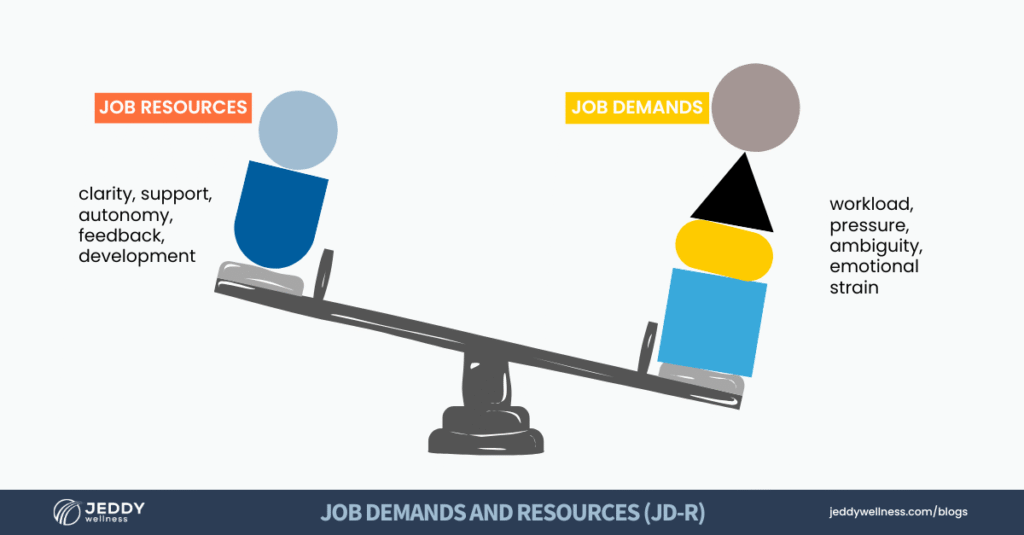
Research using the Job Demands-Resources (JD-R) model shows that leadership influences employee engagement indirectly.
Instead of directly driving motivation, leadership shapes the work environment.
It affects two key areas:
- Job demands (workload, pressure, ambiguity, emotional strain)
- Job resources (clarity, support, autonomy, feedback, development)
These conditions then shape employee wellbeing and engagement.
When job resources are strong, engagement increases.
When job demands outweigh resources, burnout becomes more likely.
How engagement actually works
Many workplaces assume:
If leadership improves, engagement will automatically improve.
But research suggests something more indirect.
Leadership shapes the work environment first. That environment then shapes how employees feel and perform.
So the real chain looks like this:
Leadership 👉 work conditions 👉 employee experience 👉 engagement
This shift matters.
It moves the focus away from “how do we motivate people?” and toward a better question.
What kind of conditions are we actually creating at work?
Three conditions that shape engagement
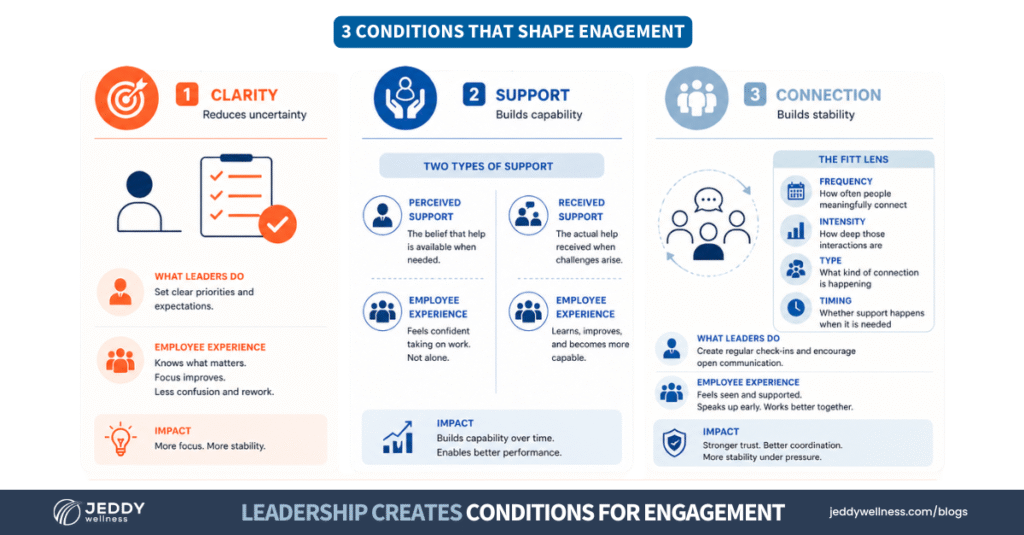
Engaging leadership works because it consistently shapes three workplace conditions.
1. Clarity reduces uncertainty
When leaders set clear priorities and expectations, employees know what matters.
For example, a leader might say:
“This week, our workload priority is completing client reports. Everything else is secondary unless urgent.”
This gives clear direction. It also removes ambiguity about what matters most.
An employee does not waste time deciding what to focus on first. Instead, they can direct their energy toward the most important work.
This reduces confusion and rework.
Without clarity, people become reactive. They spend energy guessing instead of progressing.
With clarity, focus improves and work becomes more stable.
Review 3 Types of Workload: Prescribed, Actual and Perceived [watch here]
2. Support builds capability
When leaders give feedback, remove barriers, and delegate responsibility, employees build capability over time.
It is important to distinguish between capacity and capability:
- Capacity is how much work someone can handle (time, energy, workload bandwidth)
- Capability is how well someone can perform the work (skills, confidence, judgment)
When both perceived and received support are present, employees build capability over time, not just capacity in the moment.
Perceived Support:
This is the belief that help is available when needed.
Even before challenges arise, employees feel they are not alone in their work.
Leader example:
A leader communicates clearly and says, “If you get stuck, I am here to support you.”
Employee experience:
The employee feels confident taking on work, even in uncertain situations, because support is available if needed.
Received Support:
This is the actual support someone receives when challenges arise.
It includes feedback, guidance, coaching, and practical help.
Leader example: A leader reviews work, gives specific feedback ), and helps the employee improve their approach.
Employee experience: The employee learns, improves, and becomes more capable in future tasks.
Review R2C2 Feedback: Relationships, Reactions, Content & Coaching [read here]
3. Connection builds stability
When leaders encourage collaboration and trust, employees feel more connected to their team.
This reduces isolation and improves coordination.
Connection also strengthens psychological safety, especially under pressure.
One simple way to understand whether connection is working is through the FITT lens:
- Frequency – how often people meaningfully connect
- Intensity – how deep those interactions are
- Type – what kind of connection is happening
- Time – whether support happens when it is needed
When these are low, teams can feel disconnected, even if communication appears frequent.
Leader example: A leader creates regular check-ins where team members share progress, blockers, and support needs.
Employee experience: The employee feels seen and supported. They can raise issues early instead of waiting until they escalate.
Review the FITT framework: Checklists for leaders and employees [download here]
Takeaway
Leadership does not directly create engagement. It shapes the conditions that make it possible.
We looked at three key conditions:
- Clarity reduces confusion and helps employees focus on what matters.
- Support builds capability through feedback, guidance, and trust.
- Connection creates stability through collaboration and psychological safety.
When these conditions are strong, engagement becomes more likely.
When they are weak, even strong leadership effort will not be enough.
Engagement is not driven by leadership alone. It emerges from the environment leaders help create.
Stop Scrolling, Keep Learning
If this resonated, you may also find these useful:
Written By: Sumana Jeddy Published on 2026/05/01
______________________________
Stay Connected with Jeddy Wellness
Discover evidence-based research and innovative strategies to build and activate healthier workplaces.