
 Let's Chat
Recognition at work
Employee recognition has been a workplace staple for decades.
Employee of the month programs. Service awards. Gift cards. Team lunches (pizza parties). Milestone celebrations.
These initiatives are well-intentioned. They create moments of appreciation and connection. But many organizations still struggle with engagement and retention.
This raises an important question:
Are employees not receiving enough recognition, or are we recognizing the wrong things?
The workplace has changed significantly over the past 20 years. Employees are working in more complex environments, with higher demands, hybrid structures are constantly changing (RTO mandates) are in full swing in some organizations), and ongoing uncertainty. At the same time, organizations are being asked to do more with fewer resources.
In this context, recognition serves better as a workplace resource, rather than a reward.
What the research shows
The Job Demands-Resources (JD-R) model explains how workplace resources shape employee wellbeing and engagement.
Resources help employees manage demands and maintain motivation. These include leadership support, autonomy, clarity, psychological safety and recognition.
Recognition is especially important because it signals value. It tells employees that their contribution, effort, and presence matter.
However, most recognition systems focus only on results.
We reward outcomes, targets, and milestones.
While important, results are only one part of how work actually happens.
Research by Jean-Pierre Brun and Ninon Dugas identifies four types of workplace recognition that create a more complete system.
The four types of employee recognition
Together, these forms reflect how employees experience contribution beyond performance metrics.
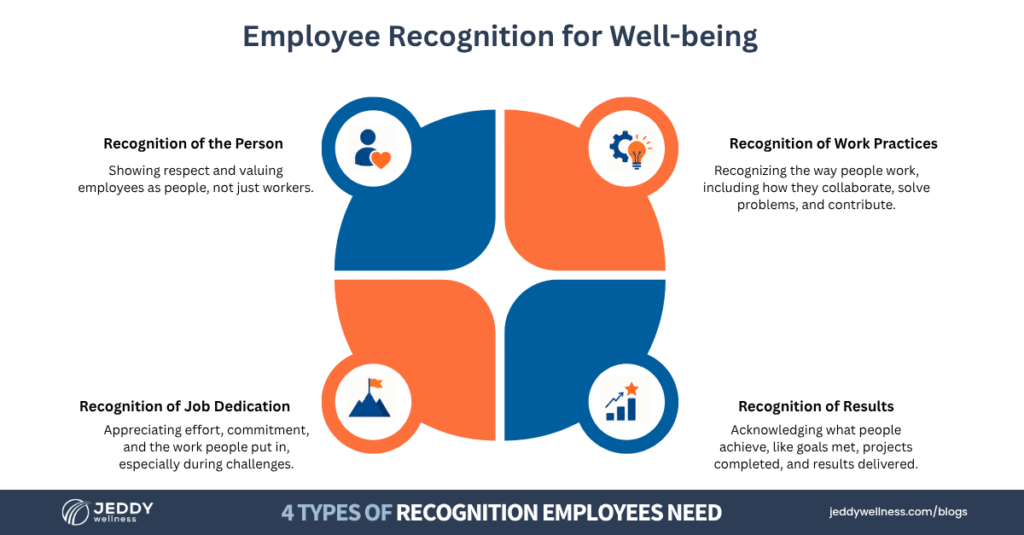
1. Recognition of the Person
Recognition begins with the individual, not the output. This type focuses on how employees are treated as people in the workplace.
It includes:
- Respectful interactions
- Inclusion in conversations
- Being listened to
- Trust
- Flexibility when appropriate
This form of recognition is often invisible in formal systems, but it shapes whether people feel valued at all.
When employees feel respected, everything else becomes easier to build on.
2. Recognition of Work Practices
Not all valuable work shows up in final results. This type of recognition focuses on how work is done.
It includes:
- Problem-solving
- Collaboration
- Creativity
- Professional judgement
- Innovation
It helps employees understand what “good work” looks like beyond outcomes alone.
Without this, people only learn that results matter, not the behaviours that create them.
3. Recognition of Job Dedication
Some of the most important contributions are effort-based, not outcome-based.
This includes:
- Persisting through challenges
- Supporting colleagues
- Adapting to change
- Managing competing priorities
- Staying engaged under pressure
This form of recognition builds trust, especially during demanding periods.
When dedication is not recognized, employees can feel that only results matter, not the effort required to achieve them.
4. Recognition of Results
This is the most familiar form of recognition.
It includes:
- Meeting goals
- Completing projects
- Achieving milestones
- Promotions and awards
Results-based recognition is important for accountability and structure.
But when it is the only form used, employees may feel that everything leading up to the outcome is invisible.
A balanced system ensures results are recognized without overshadowing people, behaviours, and effort.
How to make recognition work in 2026
In multigenerational, hybrid workplaces, recognition cannot rely on a single approach. Instead of treating recognition as a program, organizations can treat it as a shared language.
Leaders can introduce the four types of recognition with their teams so people understand what recognition can look like beyond rewards.
A simple team conversation can explore:
- What helps you feel valued as a person?
- Which types of recognition do you experience most often?
- What type of recognition is missing in your work?
- What contributions feel most meaningful to you?
When teams share a language for recognition, it becomes easier to give and receive it consistently, not just during formal recognition moments.
Stop Scrolling, Keep Learning
If this resonated, you may also find these useful:
Written By: Sumana Jeddy Published on 2026/06/01
______________________________
Stay Connected with Jeddy Wellness
Discover evidence-based research and innovative strategies to build and activate healthier workplaces.