
 Let's Chat
September can make work feel like it goes from 0 to 100 overnight.
Summer slows down. People return from vacation. New projects begin. Q4 deadlines get closer.
Suddenly, your calendar is full.
Teams notifications keep coming.
And you’re working on five things at once.
Being busy doesn’t always mean you are doing more work. Sometimes, you are just switching between more work.
Microsoft’s Work Trend Index describes today’s workday as increasingly fragmented.
Employees face interruptions from meetings, emails and chats.
In its 2025 data, Microsoft found that employees were interrupted about every two minutes during core work hours.
That raises an important question for managers:
How much of your team’s workload is work? And how much is switching between work?
That’s where the research gets interesting.
Multitasking is not just one thing
A recent diary study looked at how professional workers manage multiple tasks.
The researchers identified three types:
- Switching – Stopping one task to work on another.
- Interleaving – Moving between tasks while keeping the first task in the background.
- Overlaying – Doing two activities at the same time.
All three can fragment the workday. The study found a link between fragmented work and flow.
On more fragmented days, employees reported less flow and lower performance.
Why does flow matter?
Flow is a state of deep focus.
You are fully engaged in what you’re doing.
Frequent switching can make this harder. Some switching is necessary.
Many roles require people to respond to changing priorities.
Ask yourself and your teams: Are we creating more switching than the work requires?
What can managers and leaders do?
Managers and leaders can create more opportunities for employees to focus on one thing at a time.
You don’t need to eliminate meetings.
You don’t need to redesign your team’s workflow.
Start small. Create a short block of protected focus time.
Use this simple four-step practice in a 10-minute team meeting.
💡 Make it recurring – Add the Team Focus Check to your weekly team meeting in Microsoft Loop so the questions are already there when the meeting starts.
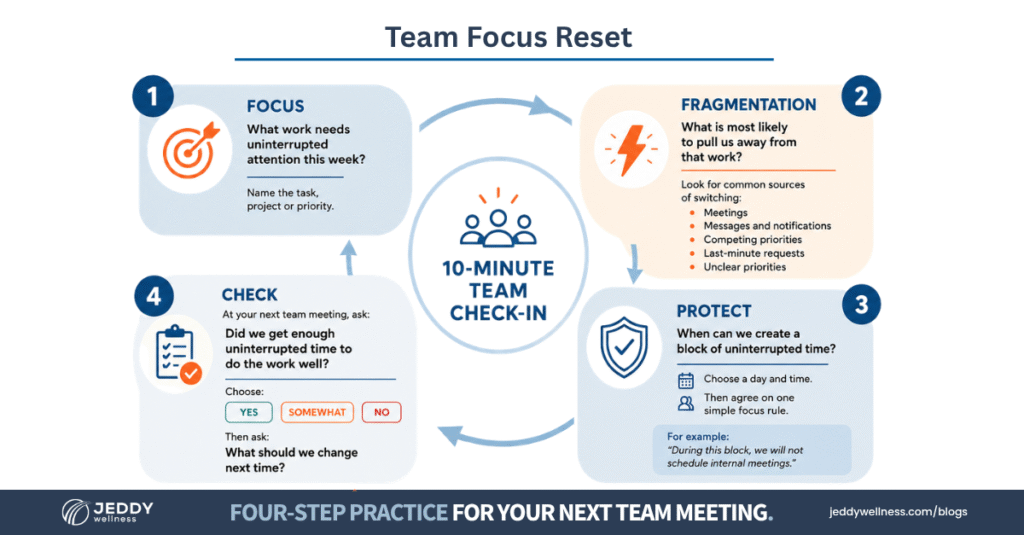
The Jeddy Wellness Team Focus Check
1. FOCUS
What work needs uninterrupted attention this week?
Name the task, project or priority.
2. FRAGMENTATION
What is most likely to pull us away from that work?
Look for common sources of switching:
- Meetings
- Messages and notifications
- Competing priorities
- Last-minute requests
- Unclear priorities
3. PROTECT
When can we create a block of uninterrupted time?
Choose a day and time.
Then agree on one simple focus rule.
For example:
During this block, we will not schedule internal meetings.
4. CHECK
At your next team meeting, ask: Did we get enough uninterrupted time to do the work well?
Choose: Yes, Somewhat, No
Then ask: What should we change next time?
One More Workload Question for Q4
We’ve previously looked at workload through three lenses:
- Prescribed: What am I expected to do?
- Actual: What am I actually doing?
- Perceived: How demanding does the work feel?
Now add a fourth question:
How fragmented is the way we’re doing the work?
Your team may not have more work. They may simply have more switching between work.
And that can change how the workload feels. As Q4 gets busier, take a closer look at how your team is spending its attention.
Stop Scrolling, Keep Learning
- Fall Burnout: Learn DRAMMA to rest and recover
- Workload: Three Types
Written By: Sumana Jeddy Published on 2026/09/01
______________________________
Contact Jeddy Wellness
We will respond to your email within 24 hours.