
 Let's Chat
And just like that, grocery and drugstore shelves are filled with heart-shaped chocolates. Love is in the air. Christmas trees are long gone. Lights are packed away. The roads are busy again. Traffic feels “normal.” Gyms are full. Any 5:00am clubbers?
There is something about the shift from January 1 to February 1 that always feels like a blur. We rest. We recover. And then, often without realizing it, we fall right back into the grind.
But this year, the grind feels different.
The job market is tighter. Economic frustration is high. Job uncertainty dominates conversations. Some lost jobs after the holidays. Others are still searching. Many quietly struggle in their current roles, hoping for a promotion, a change, or more stability.
Add holiday stress, work pressures, family demands, and financial worries. It’s no surprise that January felt heavy for many of us
Even in the midst of stress, small moments stand out: a heart-shaped chocolate, a familiar song, a kind interaction. That is the reminder that mental health matters.
At the same time, some stressors are harder to control, like returning to the office. RTO mandates are now in effect, and for many professionals, January brought not just a new year, but a brand-new routine.
This transition is often framed as a logistical or productivity issue, but it is more than that. It is a mental health issue. Commutes, scheduling meals, navigating team dynamics, and adjusting to new rhythms all add stress on top of your regular workload.
Research shows why this matters:
RTO mandates can add stress on top of workloads. Highly stressed employees take eight times more sick days and disengage at four times the rate of low-stress peers. Gallup’s 2023 and 2025 Global Workplace Reports show that extreme schedules, fully remote or fully in-office, continue to reduce engagement worldwide.
Return To Office (RTO) mandates are outside our control, but we continue to monitor them as an important workplace stressor. It is part of the larger picture of workplace mental health that we can influence and support through thoughtful operational strategies.
Building Mental Health Into How Work Gets Done
Mental health at work is most effective when it is built into systems, culture, and processes rather than being treated as a perk or individual responsibility.
A recent scoping review, “An Integrated Approach to Workplace Mental Health: A Scoping Review of Instruments That Can Assist Organizations with Implementation,” highlights that effective strategies address three domains:
- Prevent harm: reducing workplace stressors and risks
- Promote positive mental health : fostering engagement, connection, and meaning at work
- Respond to problems: providing support, resources, and accommodations when challenges arise
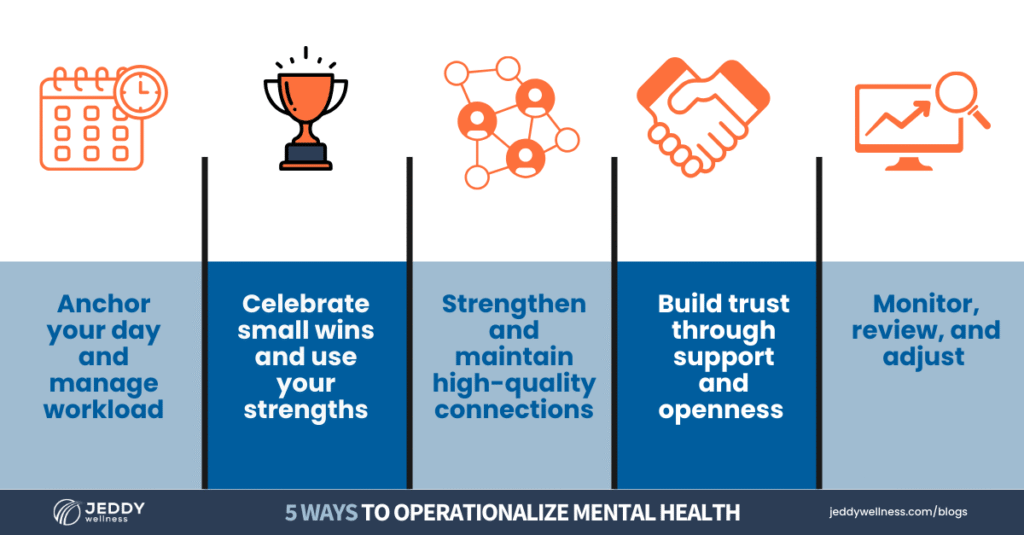
How to Operationalize Mental Health in 5 Simple Steps
- Anchor your day and manage workload: Start and end your day intentionally to separate work from personal life. Plan around your actual, prescribed, and perceived workload to avoid overwhelm and create space for focus and breaks. (Prevents harm)
- Celebrate small wins and use your strengths: Focus on tasks that energize you and match your natural strengths. Use tools like the VIA Character Strengths Survey or feedback from colleagues. Build habits that recharge you and adjust tasks that feel draining. (Promotes positive mental health)
- Strengthen high-quality connections :Strengthen both perceived support (knowing you have people to rely on) and received support (actual help when needed). Regular check-ins, peer collaboration, and meaningful interactions reduce stress and increase resilience. (Prevents harm and promotes positive mental health)
- Build trust through support and openness: Create a culture where employees feel safe speaking up, sharing challenges, and asking for help. Leaders can model transparency, actively listen, and follow through on commitments. High-trust environments reduce stress, encourage help-seeking, and improve collaboration. (Responds to problems, builds psychological safety)
- Monitor, review, and adjust: Check in regularly, use simple tools, and gather feedback to identify stress points. Adjust policies, workloads, or processes to continuously improve employee well-being. (Prevents harm and responds to problems)
Conclusion
February can feel like a tipping point. Many people start to lose steam on New Year’s goals or Q1 plans. Work pressures, stress, and the return to routine can make it tempting to give up. This is exactly why operationalizing mental health into your daily work matters.
By anchoring your day, leaning on your strengths, connecting with colleagues, fostering trust, and checking in regularly, you can maintain focus, protect your well-being, and keep moving toward your goals even when motivation dips. Effective strategies for doing this address three domains: preventing harm, promoting positive mental health, and responding to problems.
What Else to Read
Written By: Sumana Jeddy Published on 2026/02/01
______________________________
Stay Connected with Jeddy Wellness
Discover evidence-based research and innovative strategies to build and activate healthier workplaces.