
 Let's Chat
Have you ever finished a project and thought, “I hope that was okay…” Or waited weeks, sometimes months, for feedback that never came?
Maybe you have experienced:
- Projects stalling because clarity was missing
- Scope creep that could have been avoided
- Miscommunication that added stress to your day
- Or feedback that only shows up once a year during performance reviews
For many of us, feedback is either rushed, unclear, or missing altogether.
And when that happens, people feel uncertain, disconnected, or unseen and performance suffers.
As a business owner, I know this feeling well. After delivering a project, I don’t always receive feedback from clients. Sometimes they’re busy, overwhelmed, or have simply moved on to the next thing.
And sometimes, I’ve even received feedback indicating that they do not wish to participate. Ouch! When I get an email like that, I can’t help but feel confused and wonder if I didn’t perform well but usually, it’s more about their situation than my work.
Why Missing Feedback Creates Challenges
- It’s harder to know what worked and what didn’t
- It becomes difficult to refine, iterate, and improve the system.
And if this is challenging in business, imagine how much more it affects workplaces where teams rely on ongoing clarity, alignment, and connection
Feedback as a Wellbeing Tool (Integrating DRAMMA)
We often treat feedback like a performance metric something you check off or document.
But wellbeing science tells a different story.
In the DRAMMA Model, one of the strongest drivers of wellbeing and recovery is Affiliation, our need to feel connected, supported, and valued.
And good feedback does exactly that. Feedback when done well communicates:
- “I see you.”
- “I value your contribution.”
- “I want you to succeed.”
- “We’re in this together.”
And for leaders, receiving feedback from their team is just as important, it strengthens psychological safety, builds trust, and reduces the anxiety of leading in the dark.
So feedback isn’t just a performance tool.
It’s a wellbeing tool. A relationship tool. A connection tool.
Feedback flows across IGLO
Healthy workplaces do not rely on top-down communication or once-a-year reviews. Feedback should flow across all four levels of the IGLO Model:
- Individual: I share what I need, what’s unclear, what’s working.
- Group: We communicate openly, clarify expectations, and support each other.
- Leader: I model feedback that is safe, respectful, and actionable.
- Organization: We create systems that normalize feedback all year long.
When feedback flows across IGLO, workplaces become clearer, calmer, more connected and performance rises naturally.
R2C2: A Feedback Framework for Your Work-Life
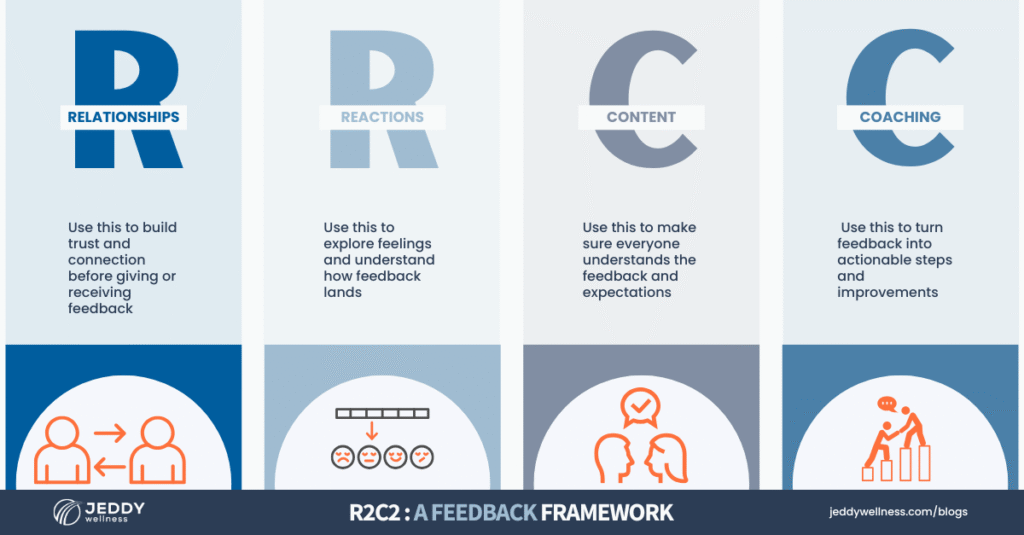
Simple, practical, Jeddy-style. The R2C2 Framework makes feedback easier and more meaningful:
- Relationship: Build trust. Start by connecting as humans.
- Reactions: Ask how the feedback feels. Listen without judgment
- Content / Understanding: Ensure everyone is clear on what the feedback means.
- Coaching / Next Steps: Turn feedback into action with small goals and support.
R2C2 takes feedback from “awkward and uncomfortable” to “clear and collaborative.”
What R2C2 Looks Like in Real Life
Here is a simple table you can use immediately:
R2C2 Phase | Leader Cue | Team Member Cue | Peer-to-Peer Cue |
Relationships | “How are things going? What’s working well?” | “Here’s what’s been going well for me and where I’m struggling.” | “How are you feeling about our work together?” |
Reactions | “How does this feedback feel? Anything surprising?” | “Here’s what stood out to me and how I feel about it.” | “What was your reaction to my feedback?” |
Content | “Here’s what I’m seeing, does this match your view?” | “Can you clarify what this means in practice?” | “What did you mean when you said ___?” |
Coaching | “What support do you need? Let’s set a next step.” | “Here’s what I can commit to next.” | “How can we support each other going forward?” |
This table gives everyone , leaders, team members, and colleagues, a simple script to start using R2C2 immediately.
After the Feedback Conversation
Most teams stop after the meeting. But meaningful growth happens after: when you process, reflect, and act on feedback.
Our 3-step reflection tool helps turn feedback into growth:
 LEARN – What did this feedback teach you? Which points were most helpful or surprising?
 LEAP – Where can you stretch? What’s one thing you can try differently or improve on?
 LOCK-IN – What will you commit to? Which actions or practices will you put in place?
This approach makes feedback a catalyst for clarity, alignment, and wellbeing, not just information.
A Jeddy Wellness Closing Thought
Feedback isn’t just a conversation, it’s a habit that builds sustainable, high-performing teams. Thoughtful feedback strengthens trust, improves clarity, and keeps everyone connected.
Use R2C2 for your next conversation: build relationships, explore reactions, clarify understanding, and coach for next steps. Then apply Learn → Leap → Lock-In to integrate feedback effectively.
Extra tip: Don’t limit feedback to internal teams. Share it with clients, partners, and collaborators. When feedback flows both ways, everyone wins.
Written By: Sumana Jeddy Published on 2026/01/04
______________________________
Stay Connected with Jeddy Wellness
Discover evidence-based research and innovative strategies to build and activate healthier workplaces.