
 Let's Chat
Rethinking how we measure workplace mental health support
World Mental Health Day is coming up.
We have written about workplace mental health before. So rather than give you another “5 things leaders can do to support mental health at work” article, we wanted to ask a different question.
Who are we seeing in our mental health data, and who might we be missing?
Most large organizations offer some form of mental health support.
Employee Assistance Programs (EAP) or Employee Family Assistance Programs (EFAP). Counselling. Mental health education. Manager training. Digital resources. Crisis support.
We know what is available. But do we know who is actually using it? And perhaps more importantly… who are we not seeing?
What do we know about EAP/EFAP use?
A 2026 study by Mark Attridge, PhD and Jason C. McDaniel examined EAP counselling data from 101,907 users in a large U.S. EAP organization.
Mental health was the most common reason people sought counselling, followed by relationship and family concerns, personal stress, workplace concerns and substance use.
That is valuable data.
But there is an important limitation.
Utilization data tells us about the people who entered the system. It does not tell us about the people who did not.
The people we do not see
Canadian research raises an interesting question.
Only about one-third of Canadians reported having access to an EAP/EFAP. Among those with access, only about 10% said they would turn to an EAP/EFAP first for mental health support. Mental Health Research Canada
If we spend a significant part of our waking lives at work, what happens when people do not use the support available to them?
Research points to several barriers including awareness, concerns about effectiveness and confidentiality, accessibility, stigma and preference for external providers. Recent research on EAP non-users.
These findings do not give us one profile of the “non-user.” They give us clues about where people may be disappearing between having a need and receiving support.
The mental health support pathway
We can think about mental health support as a pathway:
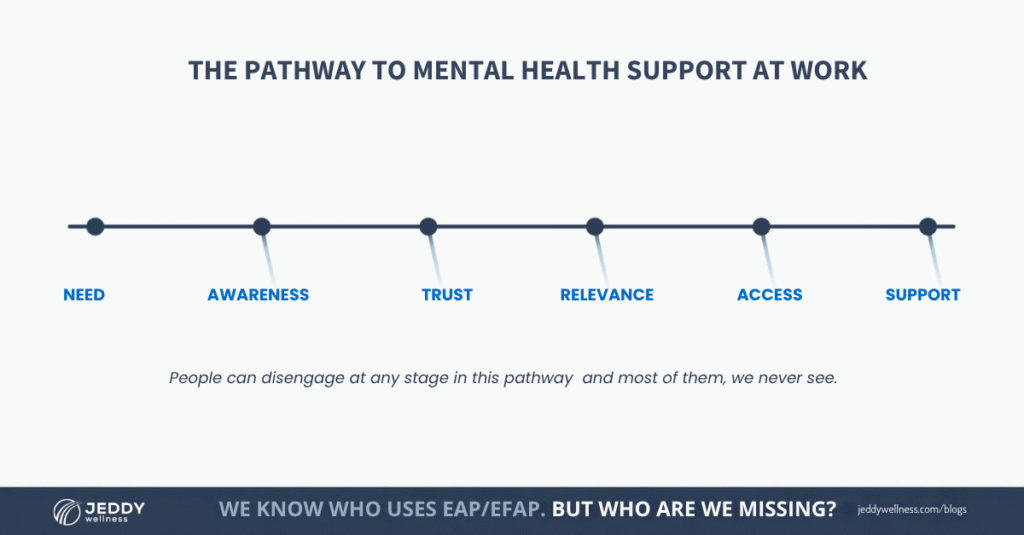
Need → Awareness → Trust → Relevance → Access → Support
At any point along this pathway, people may stop moving toward support.
- They may recognize that they need support but not know what is available.
- They may know what is available but not trust the system.
- They may trust it but decide that the service is not relevant to what they need.
- They may try to access it and encounter a barrier.
- Or they may receive support that does not work for them and decide not to try again.
The manager or leader can influence several points along this pathway.
“Have you called EAP?” or “Here is a brochure for EAP” may point someone toward support. But it does not necessarily address what happens next.
Trust especially is not built in one conversation; it is built, or broken, over months of whether someone has watched their manager treat other people’s vulnerability with care.
Offering a resource does not necessarily mean people can or will use it.
Are we measuring the right thing?
This measurement question extends beyond EAP.
Workplaces increasingly collect mental health data, screen employees and measure engagement, stress and other indicators.
But what happens when our measures primarily capture the people who respond, participate or access support?
A systematic review of workplace mental health screening found that screening followed by advice or referral did not improve employee mental health. Screening paired with facilitated access to treatment showed a small improvement, although the evidence was limited and of low certainty.
The same question applies to measurement: who is represented in the data, and who is missing from them?
The distinction matters.
Seeing a need is not the same as removing what stands between someone and support.
Ask a better question
The 2026 World Mental Health Day theme is “Lived experiences heard: real voices, real change.”
The World Health Organization is calling for people with lived experience to have a meaningful role in shaping mental health policies, services and decisions.
There is an interesting implication for workplaces.
If our mental health data primarily show the people who accessed support, we are seeing the people who made it through the pathway.
For World Mental Health Day, perhaps the question is not simply: How many people are using our mental health resources?
Perhaps it is: Whose experience are we not seeing?
And what would we design differently if we could?
Stop Scrolling, Keep Learning
Written By: Sumana Jeddy Published on 2026/10/04
______________________________
Contact Jeddy Wellness
We will respond to your email within 24 hours.